The vehicle wash sector is undergoing a transformation driven by the professionalization of operators, technological integration, and the search for new sources of profitability within service stations. In a context where the traditional revenue model is evolving and competition is intensifying, car wash is becoming a strategic business unit, where operational reliability, connectivity, and cost optimization are key factors.
Adrián Megías Paterna
In this context operates Washnet, a company that has strengthened its market positioning after a year in which it more than doubled its activity volume and consolidated its industrial structure. With a portfolio that includes car wash centres, modular solutions, and a strong foundation in spare parts and technical service, the company is committed to combining in-house manufacturing, integrated technology, and an operational structure capable of supporting both large operators and independent entrepreneurs in their growth and modernization processes.
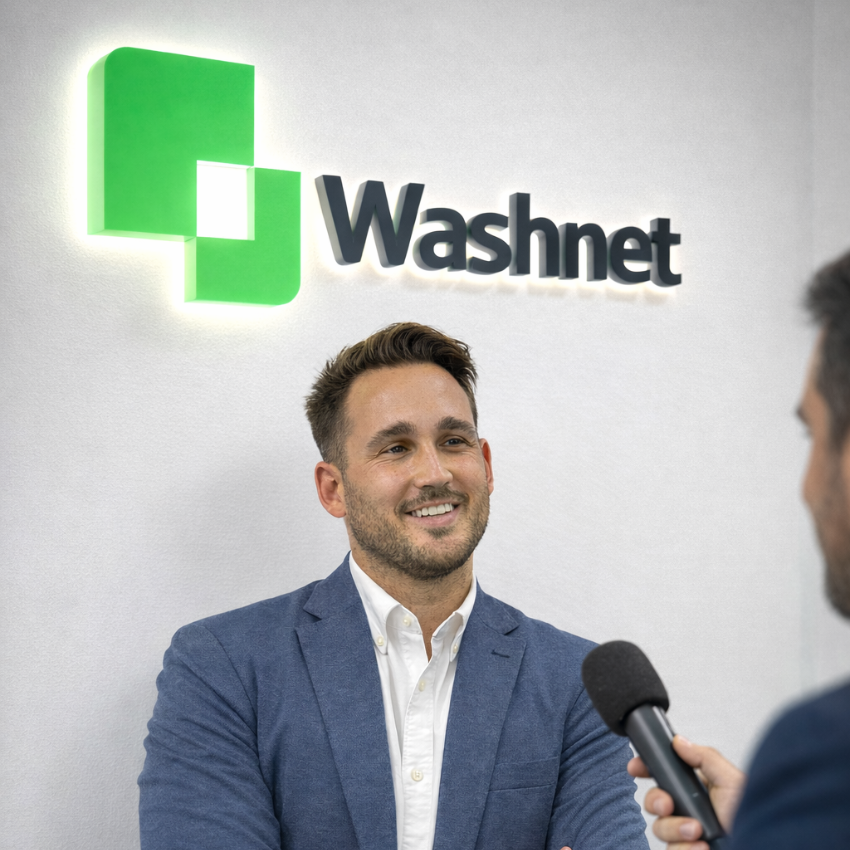
At the forefront of this new stage is Jaime Ratón, currently the company’s General Manager, who takes on the challenge of driving a structured evolution of the business. In this interview, he outlines the strategic pillars that will shape his roadmap—industrial reinforcement, connectivity, and service—analyzes the key drivers of profitability in car wash centres, and explores the role that sustainability, standardization, and international expansion will play in Washnet’s future.
What expectations do you have for this new stage at Washnet, and what do you believe you can contribute to the development of the business in the current context of the vehicle wash sector?
I approach this stage with the ambition to drive an evolution in how we understand the car wash business. The market is increasingly demanding, and it is no longer enough to simply manufacture equipment: it is necessary to have structure, execution capacity as operators grow, and integrated technological solutions.
I come from highly competitive and complex industrial environments, where I have learned that the key is not only to build a good product, but to develop a solid system behind it, where processes and operational discipline make the difference. This is the approach we are bringing to Washnet to turn it into a scalable manufacturer, capable of combining reliability, agility, and structured service for both large operators and independent entrepreneurs.
“At Washnet, we work with this approach: minimizing incidents and ensuring maximum availability of spare parts.”
Jaime Ratón
Looking ahead to this year, what will be the main lines of action shaping your roadmap as General Manager, both in terms of business growth and strengthening operations, customer service, and the company’s value proposition?
This year represents a clear phase of growth and investment, but with a strong focus on consolidating a solid industrial base that allows us to scale with guarantees.
We are working on three main pillars. First, strengthening structure and production capacity: investing in processes and planning to take on larger-scale projects without losing agility.
Second, continuing to elevate our technological standards. Connectivity was already a differentiating factor for us, and we are now moving towards more integrated and monitored solutions that allow operators to have greater control and anticipate incidents.
And third, raising the level of service. We are strengthening our Technical Assistance Service (SAT) and internal procedures to reduce response times and minimize downtime, because our clients’ profitability depends on operational continuity.
Speaking about the company, what results did Washnet achieve in the last full financial year? (in terms of activity, demand evolution, and key commercial milestones)
The last financial year has been particularly significant for Washnet. We more than doubled our activity volume compared to the previous year, with growth across all business lines: car wash centres, distribution, and technical service.
This progress reflects the trust of our clients and the commitment of our team, who have handled this growth with professionalism and strong execution capability. In addition, we have secured new tenders with major operators, strengthening our market position and supporting commercial development in the short and medium term.
Beyond the figures, the year has been key in reinforcing our structure and preparing the company for a more demanding phase of expansion.
With a portfolio ranging from car wash centres and mobile laundries to customized containers and smart stores, what trends do you currently consider most relevant in the car wash and automated services sector, and what strategic lines has Washnet activated to anticipate and adapt to these market changes?
The sector is changing. Car wash is no longer seen as a complementary service, but as an important part of the service station business. At a time when the traditional revenue model is evolving, having services that generate traffic and provide stability is becoming increasingly relevant.
At Washnet, in line with the group’s vision, we understand the station as a space where different services are combined. Car wash centres, modular solutions, and smart stores all respond to this idea: offering more options to the customer at a single location and making better use of each site.
Our response to this evolution is to continue strengthening connectivity, modularity, and the quality of our solutions, ensuring they are easy to implement, manage, and adapt to different formats.
As a pioneering company in the supply of spare parts for the car wash sector, how has Washnet built, from that experience, a comprehensive value proposition that goes beyond equipment and is supported by service, engineering, and continuous support?
We were pioneers in the distribution of spare parts for car wash professionals, and that stage allowed us to truly understand what an operator needs: immediate availability, technical compatibility, fast response times, and above all, operational continuity.
This experience has shaped the way we design and manufacture. Today, we develop our equipment with the full lifecycle in mind from the very beginning: ease of maintenance, component standardization, and a fully aligned spare parts and technical service structure.
For us, product and service go hand in hand. It is not just about installing a site, but about supporting it throughout its entire lifecycle.
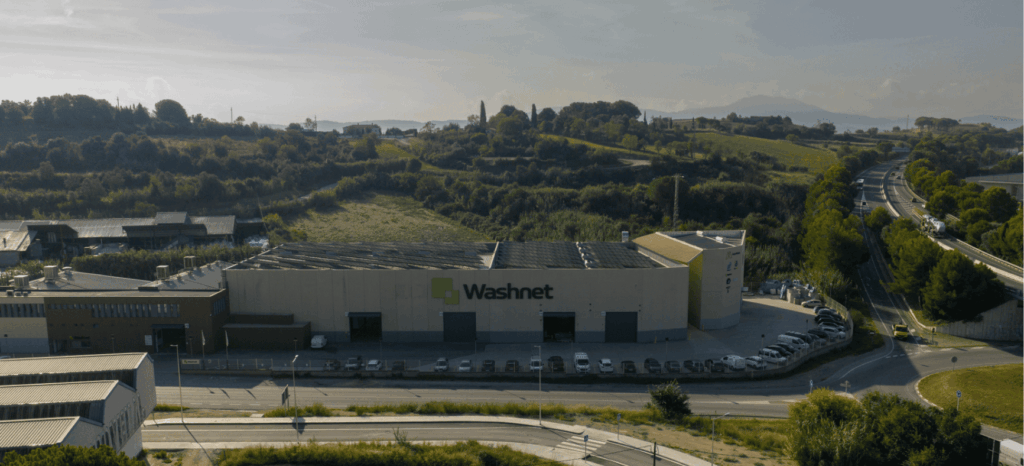
Washnet has moved to new corporate facilities in Les Franqueses del Vallès (Barcelona), with a larger and more modern manufacturing plant, covering a total surface area of 9,600 m².
What weight do service stations currently have in your mix (multi-energy operators, independents, franchises)? And what types of projects are most common: new builds, refurbishments, expansions, rebranding, etc.?
Service stations are now a very important segment for us, both among large operators and independents and franchises that want to strengthen car wash as a key part of their business.
In terms of projects, new builds are currently predominant, especially among operators who are expanding their networks or incorporating car wash as a structural service within the station.
At the same time, we are seeing more and more refurbishments and upgrades of existing facilities. Many operators are modernizing their sites to improve image, efficiency, and performance, which shows that the sector is taking another step towards professionalization.
What role will sustainability and technology play in new Washnet Factory projects?
Sustainability and technology are part of our new projects from the very beginning. We are not only talking about reducing water or energy consumption in the installation, but also about how we design, how we manufacture, and which suppliers we work with.
We believe that real sustainability involves reviewing the entire process and assuming shared responsibility across the whole value chain, not just in the final product.
En cuanto a tecnología, la conectividad y la monitorización nos permiten optimizar consumos, anticipar incidencias y facilitar la gestión diaria del centro.
What is a service station currently looking for when investing in car wash: visual differentiation, robustness, speed of implementation, maintenance, reduction of downtime, local marketing, etc.?
Today, service stations are primarily looking for peace of mind and profitability. They want robust equipment that works without surprises and minimizes downtime, because every incident directly impacts both revenue and brand image.
Speed of implementation is also important, as timelines are usually very tight. And, of course, the car wash must fit with the station’s image and be easy to manage and maintain on a daily basis.
Ultimately, the operator is not just investing in a machine, but in a service that must operate consistently and add value to the overall station.
Following the contract award to provide service to Moeve in Spain and Portugal, what does this represent in terms of volume, operational demands, and standardization? What lessons has it provided for scaling with other large operators?
Trabajar con Moeve en España y Portugal ha supuesto un salto importante en volumen y, sobre todo, en nivel de exigencia. Un operador de esta dimensión necesita planificación, coordinación y una forma de trabajar muy ordenada.
The connectivity of our installations was a key differentiator, and this project has allowed us to further enhance it and take it to a higher level.
In my experience, both here and in my previous stage in the automotive industry, working with large accounts teaches you something very clear: they need structured suppliers—but also agile ones. When they want to grow quickly, they cannot wait. And that is where the organization behind the business is truly put to the test.
The lesson is simple: to scale, it is not enough to have a good product—you need a team, processes, and technology that support that growth.
In this context, and considering Washnet’s presence at international trade fairs such as UNITI Expo and expoMecânica, are there concrete plans to strengthen or expand the company’s international presence? Which markets or growth strategies are a priority in your roadmap?
Our presence at trade fairs like UNITI Expo is not something occasional. It is part of a clear strategy for growth outside Spain, understood as a step-by-step process rather than an improvised expansion.
We are particularly interested in European markets where operators value industrial quality, connectivity, and reliability. That is where our model fits best.
We prefer to grow through strong local partnerships and well-structured projects, rather than doing it quickly. We do want to expand, but always with coherence and real execution capacity.
To conclude, why do you believe this is a good time to invest in vehicle washing, and what can Washnet offer to those considering taking that step?
It is a good time because car wash has established itself as a stable and recurring business within service stations. In a context where the traditional model is changing, having services that generate traffic and consistent margins is becoming increasingly important.
In our case, we also speak from experience. We have spent years designing and manufacturing car wash centres, and we are part of a group that also operates this type of service station. This gives us a very real understanding of what works: reliability, cost control, and day-to-day operational continuity.
To those considering taking this step, we can offer exactly that: practical experience, in-house manufacturing, integrated technology, and a service that supports them לאורך the entire process. We know how to design a site, but also how it must operate every day to ensure the business is profitable.
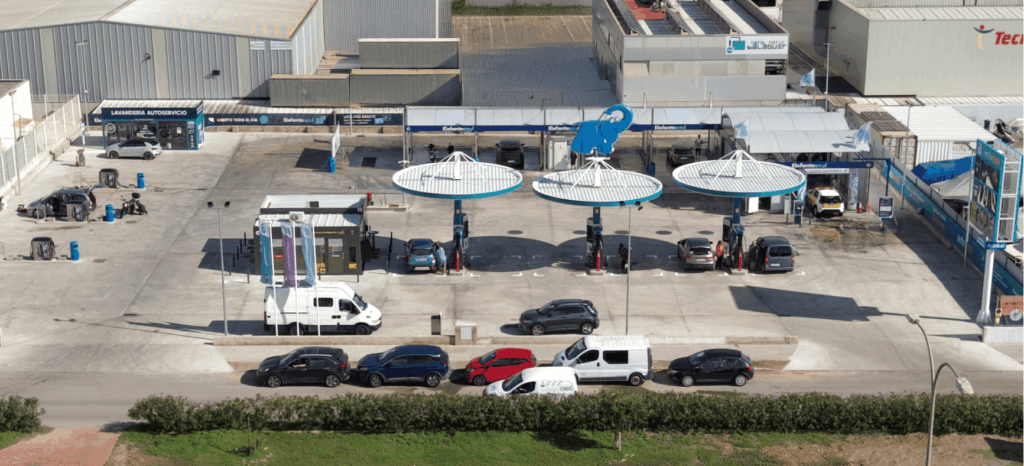
Example of design, manufacturing, and installation by Washnet for Elefante Azul and Autonetoil in Ibiza.